She has stayed with you for four nights. The front desk knew her name before she reached the counter, her key was ready, her arrival noted on the reservation. By any measure it was flawless. And yet at dinner on her second evening, the restaurant greeted her like a stranger who had wandered in off the street — no idea she was a guest at all, let alone one who asks for a corner table and sparkling water with no ice.
Nothing was broken, exactly. Everyone did their job. The check-in was warm, the food was good, the room was spotless. But somewhere between the lobby and the dining room she quietly stopped being a person and became a transaction — and she felt it, even if she could never quite name it. Multiply that feeling across thousands of guests, at every property that runs this way, and you are looking at one of the most expensive problems in hospitality. Almost no one treats it as the problem it actually is.
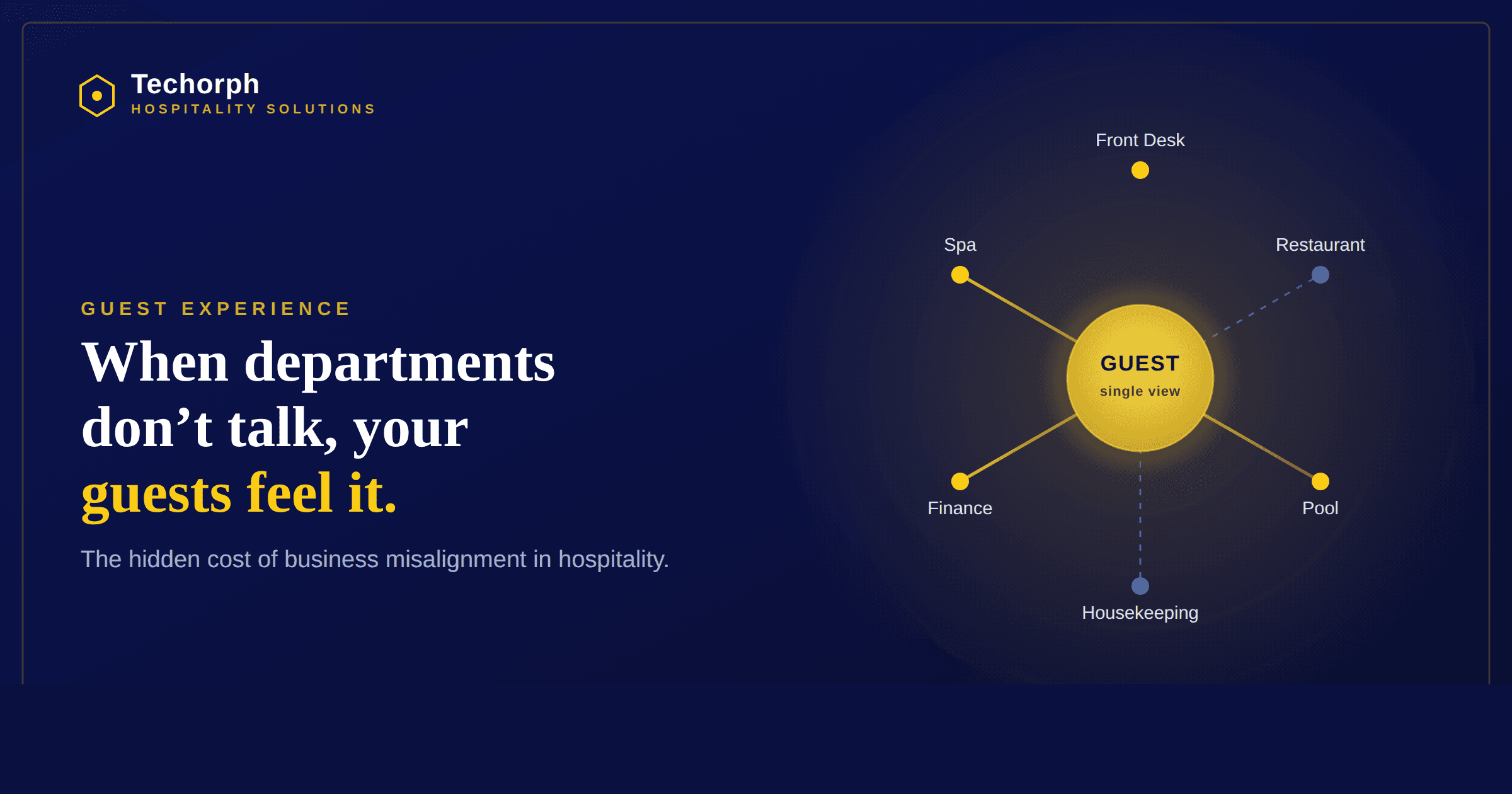
Here is the uncomfortable truth: this is not a service failure. It is a structural one. Most hotels do not have a service problem — they have an operating-model problem that merely looks like one. We diagnose weak guest experience at the level of the individual and answer it with more training and tighter procedures. But the colleague is rarely the point of failure. The property runs as a portfolio of functional silos — rooms, food and beverage, spa, housekeeping, finance — each on its own data, none sharing a single view of the guest.
How Recognition Dies at the Lobby Doors
Follow her a little further and the pattern becomes impossible to unsee. The warmth captured at reception never travels with her. She is greeted by name at check-in, then meets the restaurant host as a stranger, the pool attendant as a stranger, the spa receptionist as a stranger — every interaction starting from zero, because there is no shared guest profile any of them can see in the moment it would matter.
And the breakdown compounds in the places guests remember most. The preferences she mentions in passing are captured in conversation but never written to a system of record, so the colleague who hears them owns them and the hotel does not. Her restaurant charges are reconciled by hand at night audit rather than flowing automatically between the point-of-sale and the property management system — a quiet revenue leak that also turns her final morning into a billing dispute at checkout. Housekeeping sends a different attendant each day with no way to carry her preferences forward, so the room is serviced but the guest is never actually known. None of this is a lapse in anyone's diligence. It is the predictable output of systems that do not talk to each other — and it makes anticipatory service, the very thing a luxury property is selling, impossible by design rather than by effort.
What It Quietly Costs You
Play that scene forward across a year and the cost stops being a feeling and starts being a number — three of them, in fact, that every owner already underwrites without realizing they are connected. The first is retention: Fred Reichheld's research at Bain & Company found that lifting customer retention by just five points can raise profits by 25 to 95 percent, and the experience that earns a return visit is precisely the one that proves the hotel remembered — which a fragmented operation cannot do. The second is personalization: McKinsey puts the revenue lift from getting it right at 10 to 15 percent, an upside that stays purely theoretical when you cannot make a relevant offer to a guest you do not actually know. The third is the slow bleed of ancillary spend and total revenue per available room, both suppressed every time the property fails to turn what it learns about a guest into a timely, tailored invitation. Individually, each is easy to miss. Together, they are the difference between a hotel that fills rooms and one that compounds relationships.
Your Best People Feel It Too
And the guest is only half the story. The same misalignment that quietly costs you loyalty is also draining the people you can least afford to lose. Hospitality already carries the highest attrition in the economy — leisure and hospitality turnover in the United States runs above 70 percent a year, roughly five times most industries, according to the U.S. Bureau of Labor Statistics — and Cornell's School of Hotel Administration has put the fully loaded cost of replacing one employee near $5,900 once recruiting, onboarding, training, and lost productivity are counted.
Now picture the job from the inside. Your colleagues are told to deliver excellence, then denied the tools, the information, and the process to do it. They apologize for billing errors they did not cause, guess at preferences they were never handed, and watch guests leave unhappy through no fault of their own. The daily experience of being set up to fail is exactly what turns a service career into a revolving door — and every departure resets what little institutional memory the hotel had managed to keep.
One Chain, Running Backward
By now the connection should be clear: none of these problems is separate. They are links in a single chain — the well-documented service-profit chain that ties internal alignment to employee satisfaction, employee satisfaction to service quality, service quality to guest loyalty, and loyalty to profit. In a healthy business that chain pulls in your favor. In a misaligned one it runs in reverse — fractured operations sour the employee experience, which erodes service, which costs you loyalty, which surfaces in the P&L. Most properties are running the chain the wrong way and treating each broken link as its own separate crisis, when the lever is the same in every one: whether the operation is aligned enough to let good people do good work.
You Cannot Renovate Your Way to Loyalty
Which leads to the question every owner eventually answers with a budget. When guest scores slip and repeat business softens, the instinct is to reinvest in the asset — a new lobby, refreshed rooms, a better spa. But a renovation improves the building; it does nothing for the operating system that decides whether a guest is recognized, anticipated, and given a reason to come back. That is why the more beautiful property loses, again and again, to the more aligned one down the street — the competitor where the systems quietly make every interaction informed, where the server already knows her name and the offer waiting in her inbox feels personal rather than generic. You can renovate the asset. You cannot renovate your way to loyalty.
Luxury Is an Operating Model
So where does that leave the definition of luxury? Not, it turns out, at a finish level. Luxury is an operating model — aligned departments, integrated systems, and a single source of guest truth, governed with the same seriousness as the capital plan. The properties that win the next decade will not be the ones with the most marble or the highest thread count. They will be the ones that treated business alignment as the foundation of the guest experience rather than a detail to sort out later. Get that right, and everything you were chasing — service excellence, ancillary revenue, retention, loyalty — stops being a goal and becomes a byproduct. Get it wrong, and no amount of beauty will bring her back for a fifth night.
Start by Finding Your Blind Spots
You cannot fix what you cannot see, and most misalignment hides in the seams between departments where no single manager is looking. Before the next capital decision, it is worth knowing precisely where your operation is aligned and where guests are quietly slipping through the gaps — which systems actually talk to each other, where the guest profile breaks, and how much revenue and loyalty the disconnects are costing you. That is exactly what a structured assessment surfaces: an honest map of where you stand today, and where the highest-value fixes are hiding.